
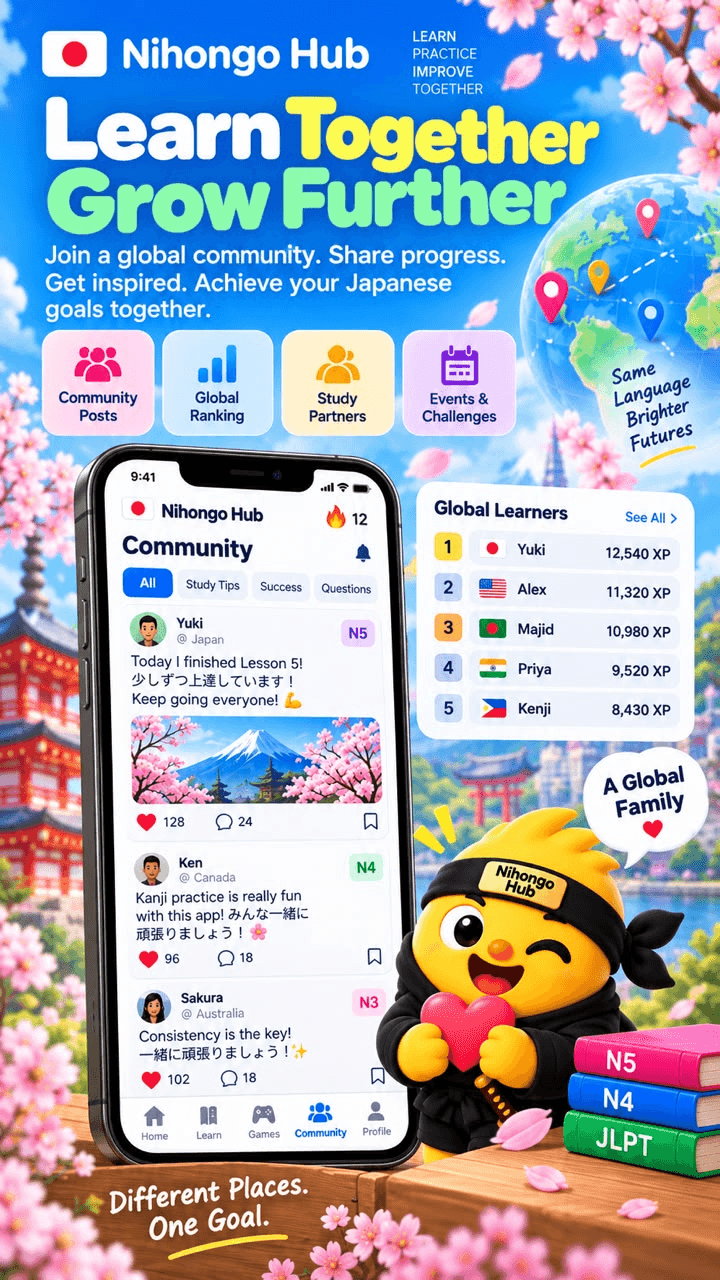
Studying with other people can make Japanese feel more real. You hear different voices, notice different memory tricks, and get a reason to use a phrase outside a worksheet. A good learning circle does not require everyone to be at the same level. It needs a shared pace, kind correction, and a small activity everyone can finish.
Begin with a ten-minute check-in. Each person shares one word from the week and one sentence using it. A beginner might say 今日は水を飲みます (きょうは みずを のみます, today I will drink water). Another learner can ask 何を飲みますか (なにを のみますか, what will you drink?). The answer can be simple: お茶を飲みます (おちゃを のみます, I will drink tea). This creates meaningful repetition of を and the polite verb ending ます.
Agree on how corrections work. First, let the speaker finish. Then repeat the sentence naturally and explain one change. If someone says わたしは日本語を勉強です, you can model わたしは日本語を勉強します (I study Japanese). 勉強する is a verb, so polite speech uses 勉強します. One clear correction is easier to remember than a list of every possible improvement.
Shared practice also helps with listening. Read a short line once, then ask the group to catch one familiar word. Do not demand a perfect translation. In これは本です (これは ほんです, this is a book), the target might simply be 本. On the second reading, notice これ, “this,” and the topic pattern は. Confidence grows when learners are allowed to understand in layers.
Keep the group small enough for everyone to speak. A weekly theme such as food, travel, or daily routines gives structure without making the meeting feel like a class. Use picture prompts, a tiny dialogue, or a five-question quiz. End by choosing one phrase to reuse during the week. A shared promise such as “say ありがとう three times in context” creates continuity.
Be careful with level labels. N5 is a useful beginner target, but it does not describe every learner’s identity or ability. Someone may know useful phrases without knowing much grammar; another person may read kana comfortably but hesitate to speak. Compare progress with your own previous week.
NihongoHub’s planned community direction supports this kind of gentle connection while the initial product focuses on beginner–N5 learning. Until then, share the hiragana guide, explore characters, and use the mindmap to choose a common topic. Learning together works best when the invitation is simple: bring one word, ask one question, and leave with one phrase to use.
Give everyone a comfortable role
A group can rotate roles: one person reads the prompt, one asks the question, and one keeps a list of useful phrases. Next time, swap. Beginners who are shy about speaking can start by pointing, reading, or choosing between two answers. Participation can grow gradually. The purpose is connection and practice, not performance.
Use repair phrases so conversation does not stop. もう一度お願いします (もういちど おねがいします, one more time please) asks for repetition. ゆっくりお願いします (ゆっくり おねがいします, slowly please) asks for a slower pace. わかりません (I do not understand) is also useful and honest. Learning these phrases gives everyone permission to keep the conversation moving.
After the meeting, send one written example and one question. A learner might share 週末に映画を見ます (しゅうまつに えいがを みます, I will watch a film on the weekend) and ask 何を見ますか (what will you watch?). The exchange is short, but it creates a bridge to the next meeting and makes grammar memorable.