
Learning Japanese becomes easier when the first question is not “How much can I finish?” but “What would I enjoy noticing today?” A sustainable beginner routine makes room for curiosity, repetition, and rest. You do not need a perfect study plan; you need a small next step that you can repeat.
Start with one visible goal. For a first week, that might be recognising the five vowels in hiragana: あ (a), い (i), う (u), え (e), お (o). Say each sound aloud, write it once, and meet it again in a short word such as あさ (asa, morning) or いえ (ie, house). The goal is familiarity, not speed. If a character feels difficult, circle it and return tomorrow instead of turning the session into a test.
A useful 20-minute session has three parts. Spend five minutes reviewing yesterday’s characters or words. Spend ten minutes meeting something new. Finish with five minutes of easy recall: read a tiny phrase, point to the right answer, or write one sentence. A beginner sentence such as わたしは学生です (わたしは がくせいです, I am a student) gives practice with は, the topic marker, and です, a polite sentence ending. You can learn the grammar more deeply later; first let the pattern become familiar.
Keep a “small wins” note. Write down a word you recognised on a train sign, a phrase you understood in a video, or a character you wrote without checking. These moments are evidence that practice is working. They also tell you which material feels meaningful. If you enjoy food, learn ごはん (meal), みず (water), and おいしい (delicious). If you enjoy travel, try えき (station), でんしゃ (train), and ここ (here).
Japanese rewards gentle repetition. Review words after one day, then a few days later, then the following week. Mix recognition with production: read ねこ (cat), then try to write it; hear ありがとう (thank you), then say it naturally. Keep the examples short enough that you can understand why each word is there.
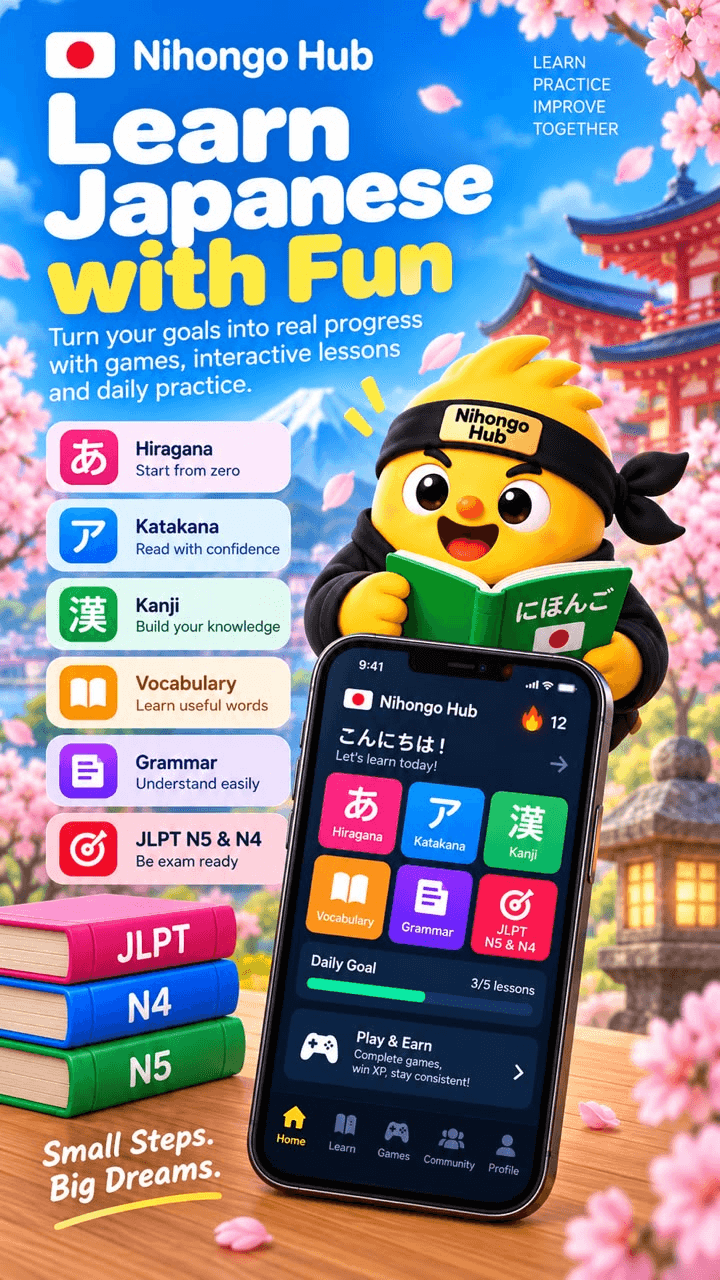
NihongoHub’s beginner–N5 path is designed around this kind of progress: characters, vocabulary, grammar, and practice that fit into a real day. Use the hiragana guide when you need a clear first map, then explore characters and the language mindmap when you are ready to connect ideas. A joyful routine is not a shortcut. It is the reason you return often enough for Japanese to stay with you.
A simple weekly rhythm
Choose three short sessions for new material, two for review, and one relaxed session for reading or listening. On the seventh day, look back at your small wins. Adjust the next week around what you actually used, not what an ideal learner might do.
Make the next session obvious
Leave your notebook, app, or flashcards where you will see them. Decide the first action before you stop: “Tomorrow I will review いえ and あさ.” This removes the small decision that often becomes procrastination. Keep a second, even smaller option for difficult days: read one line, listen to one word, or trace one character. A routine survives because it has a gentle version.
Joy also comes from choosing material that reflects your life. Change a character’s name to your own, describe your breakfast, or label objects on your desk. Try これはペンです (これは ペンです, this is a pen) and これは本です (これは ほんです, this is a book). The sentences are simple, but they turn study into observation. When a word appears in your day, it has somewhere to live.
At the end of each week, keep one example and release the rest. You do not need to remember every new word immediately. A smaller set understood well gives you a base for the next set. Celebrate returning, noticing, and trying again; those are the habits that carry a beginner toward N5.