
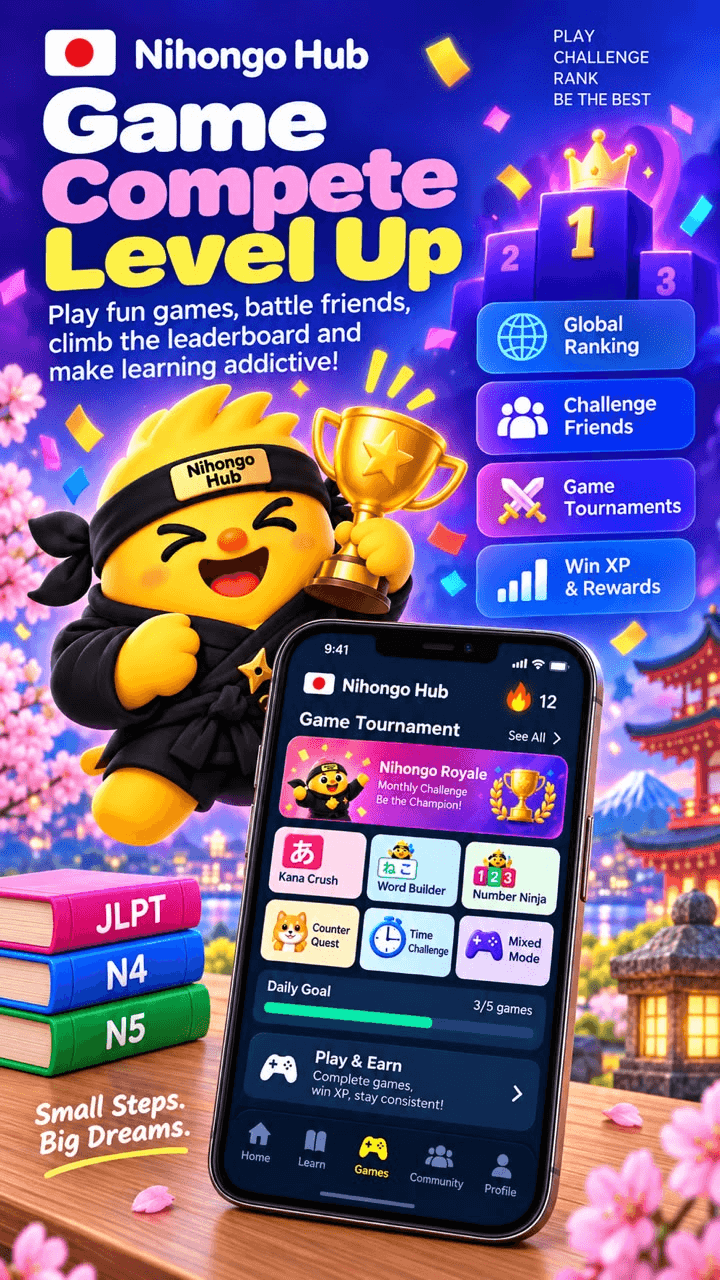
Practice feels lighter when every round has one clear purpose. Instead of opening a lesson and wondering what to do, choose a small challenge: recognise five kana, match three words to pictures, or build one polite sentence. A playful format gives your attention somewhere to land, while repetition turns that attention into memory.
Try a “three-round” break. In round one, recognise: read さかな and say さかな (sakana, fish). In round two, retrieve: hide the reading and recall it from the meaning. In round three, use it: write さかなを食べます (さかなを たべます, I eat fish). The particle を marks the thing receiving the action. You do not need a long explanation to benefit from seeing the pattern several times.
Games are most useful when feedback is specific. If you confuse ぬ and め, review their shapes together and write each one slowly. If you choose the wrong particle, read the full sentence aloud and ask what role the noun has. A mistake is a useful signpost. Correct it, then meet the same idea in a new example later.
Mix recognition, recall, and timing. Recognition asks “Which answer is right?” Recall asks “Can I produce it without a prompt?” Timing asks “Can I do it comfortably in a real moment?” Beginners should spend most of their time on accuracy, then let speed grow naturally. Ten careful answers are more valuable than a rushed streak that teaches guessing.
Keep Japanese examples small and natural. For greetings, practise おはようございます (good morning), こんにちは (hello), and ありがとうございます (thank you). For location, compare ここは学校です (ここは がっこうです, this is a school) with そこは駅です (そこは えきです, that place is a station). Notice how は introduces the topic, while です closes the polite statement.
A good practice loop ends before your attention disappears. Stop after a successful round and note what to revisit tomorrow. This protects motivation and makes the next session easy to start. On a busy day, two minutes of kana recall still counts. Consistency is built from sessions that fit the day you actually have.
NihongoHub’s beginner–N5 focus uses playful practice as one part of a wider path. Pair a short round with the N5 reading practice guide, review particles with Japanese particles for beginners, and use quizzes when you want a focused check. The aim is not to turn every break into a competition. It is to make returning to Japanese feel inviting.
Try the Mixed Quiz in a session that fits
On the Mixed Quiz, choose Both for Hiragana + Katakana, then select forward, reverse, or mixed direction. The timed challenge offers a 1, 3, or 5 minute session. Use one minute to warm up, three minutes for a regular break, or five minutes for a longer review. The timer ends the run; it is a practice limit, not an exam prediction.
When the run finishes, results show accuracy, correct answers, answered questions, duration, and missed items to review. The app automatically stores the best timed accuracy in this browser. Share the challenge or copy its link so a friend can play the same settings; their result is compared with the inviter’s score on the challenge page. This friend flow is available for Mixed Hiragana + Katakana challenges. Broader community rankings are upcoming.
Design a fair challenge
A good challenge is just beyond what you can do comfortably. If every answer is obvious, add a short timer only after accuracy is steady. If every answer is a guess, reduce the set and add a hint. You can make a card with the Japanese on one side and a situation on the other, then alternate which side you see first. This keeps practice active without turning it into pressure.
Try a “find the difference” round with particles. Compare 学校に行きます (がっこうに いきます, I go to school) and 学校で勉強します (がっこうで べんきょうします, I study at school). に marks a destination, while で marks the place where an action happens. Say both aloud and imagine the movement in each sentence. A tiny contrast can teach more than a page of disconnected definitions.
Record your result in words rather than only a score: “I recognised kana quickly but forgot two foods.” That note tells you what the next round should include. Playful practice works when it gives you a clear next move.
The Kana Matching game is another option for untimed recall: flip cards and pair kana with romaji. Switch to characters when a quiz exposes a shape you need to inspect closely.